

Content governance streamlines workflow, ensures quality, and enhances AI search visibility. Learn models, roles, risks, and best practices.
Complex workflows and scattered content can frustrate even the most efficient teams. For American SaaS companies scaling across channels, content governance brings much-needed clarity and control. By uniting policies, roles, and workflows, organizations achieve consistent quality and protect their brand from legal risks. This guide outlines proven frameworks that help content leaders optimize operations, minimize risk, and set the stage for powerful AI integration.
Key Takeaways
| Point | Details |
|---|---|
| Content Governance Framework | Establishes guidelines and processes to manage digital content effectively, ensuring quality, consistency, and strategic alignment. |
| Roles and Responsibilities | Clearly defined roles within the content governance model enhance accountability and streamline content production workflows. |
| Legal Compliance | A robust governance framework includes mechanisms for reducing legal risks and ensuring adherence to industry regulations. |
| Workflow Optimization | Implementing structured workflows and integrating AI can significantly improve content creation efficiency and scalability. |
Defining Content Governance and Core Concepts
Content governance represents a strategic framework that transforms how organizations manage digital content across complex operational environments. At its core, content governance is the systematic approach organizations use to maintain quality, consistency, and strategic alignment of their content resources.
According to content science research, content governance encompasses a comprehensive set of interconnected elements:
- Policies: Documented guidelines defining content standards
- Standards: Specific criteria for content creation and management
- Roles: Clear responsibilities for content production and approval
- Workflows: Structured processes for content development
- Decision Frameworks: Mechanisms for strategic content choices
The primary objective of content governance extends beyond mere administrative control. It serves critical strategic functions that enable organizations to:
- Maintain consistent brand messaging
- Mitigate potential legal and compliance risks
- Optimize content creation efficiency
- Ensure scalable content production
- Support cross-functional collaboration
Content Operations sit at the intersection of strategy, technology, and human processes. By establishing clear protocols, organizations can transform content from a fragmented activity into a synchronized, high-performance system.

The following table highlights the impact of strong content governance on business performance:
| Aspect Impacted | Measurable Benefit | Organizational Result |
|---|---|---|
| Brand Consistency | Uniform messaging | Improved customer trust |
| Legal Compliance | Reduced risk exposure | Fewer legal challenges |
| Workflow Efficiency | Faster content delivery | Lower operational costs |
| Scalability | Easier process expansion | Quicker market adaptation |
| Collaboration | Clear roles and handoffs | Stronger team productivity |
Content governance is not about restricting creativity, but about creating a predictable, reliable framework that allows teams to innovate effectively.
Pro tip: Start by documenting your current content creation processes and identifying inconsistencies before designing your governance framework.
Common Models and Frameworks Explained
Content governance frameworks provide structured methodologies for managing digital content across organizational ecosystems. These models offer strategic approaches to standardizing content creation, distribution, and management processes while maintaining flexibility for unique team requirements.
Key Content Governance Framework Models include:
- Centralized Model: Single team controls all content creation and approval
- Decentralized Model: Content creation distributed across different departments
- Hybrid Model: Combines centralized standards with localized content production
- Hub-and-Spoke Model: Central content team sets standards, distributed teams execute
Each framework offers distinct advantages depending on organizational complexity and strategic objectives. The centralized model works best for smaller organizations with consistent brand requirements, while hybrid approaches suit larger, more complex enterprises with multiple content needs.
The table below summarizes how different content governance models align with specific organizational needs:
| Model Type | Best For | Strengths | Possible Limitation |
|---|---|---|---|
| Centralized | Small teams, single brands | High consistency | Slow response to local needs |
| Decentralized | Large, diverse organizations | Fast local content | Risk of inconsistency |
| Hybrid | Enterprises with shared goals | Balanced oversight | Complex coordination |
| Hub-and-Spoke | Global brands, franchises | Scalable best practices | Needs strong central team |
Strategic Considerations for Framework Selection
Choosing the right content governance framework requires careful evaluation of several critical factors:
- Organizational size and complexity
- Content production volume
- Brand consistency requirements
- Cross-functional collaboration needs
- Technology infrastructure
Successful content governance is less about rigid control and more about creating adaptable systems that empower creative teams.
Implementing these frameworks requires a nuanced understanding of organizational dynamics. Successful models integrate technological capabilities, human creativity, and strategic alignment to transform content from a tactical activity into a strategic asset.
Pro tip: Conduct a comprehensive content audit before selecting your governance framework to understand your current content ecosystem and identify specific organizational needs.
Key Elements: Roles, Policies, Workflows
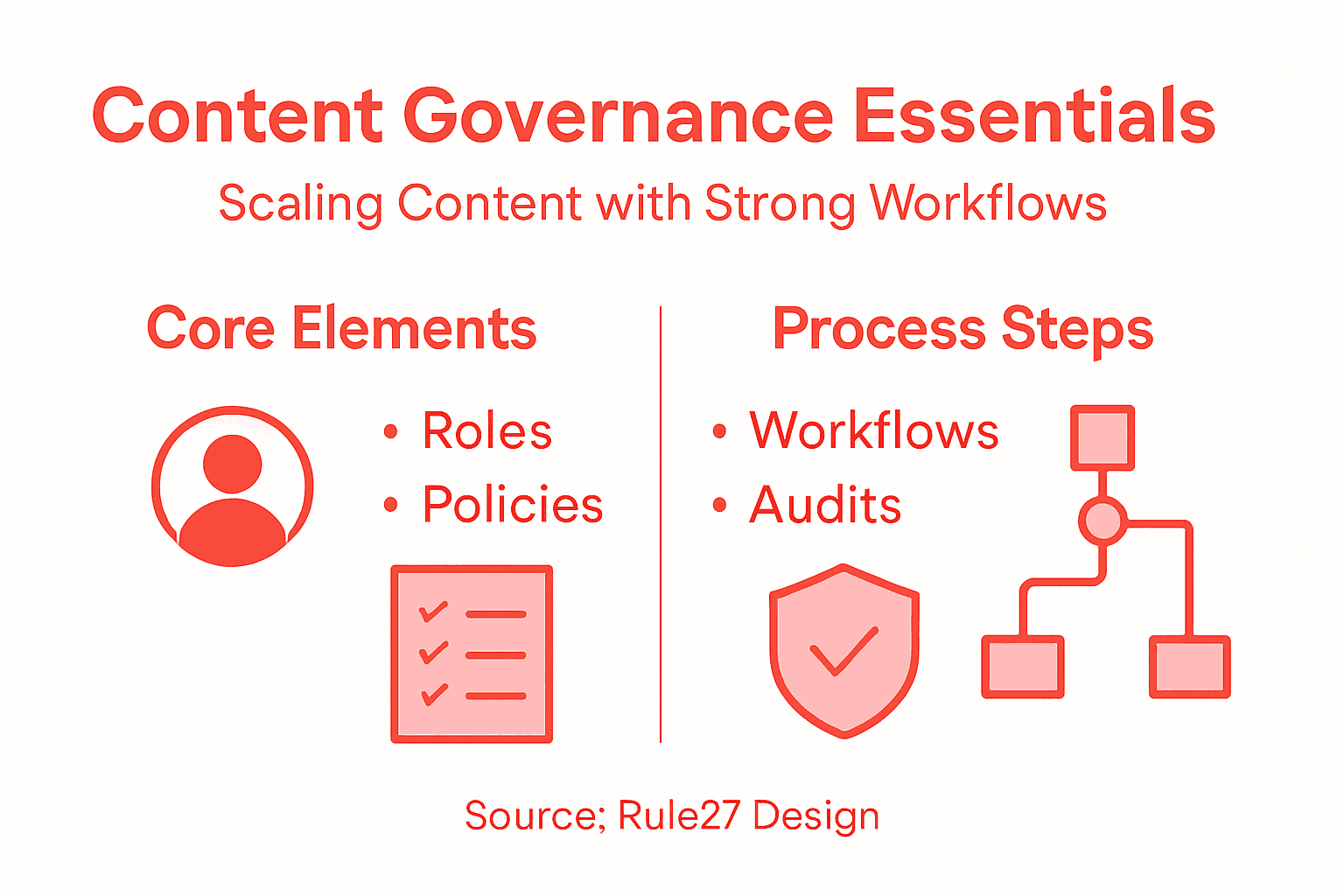
Content governance demands a sophisticated approach to structuring organizational content operations. The core framework comprises three critical interconnected elements: roles, policies, and workflows that together create a comprehensive content management system.
Defining Organizational Roles
Key Content Governance Roles typically include:
- Content Strategist: Develops overarching content vision and direction
- Content Manager: Oversees content production and quality control
- Subject Matter Experts: Provide specialized knowledge and technical validation
- Editorial Team: Ensures brand voice, style, and grammatical consistency
- Approval Managers: Final review and sign-off on content assets
Developing Robust Policies
Effective content policies establish clear guidelines that maintain brand integrity and operational consistency. These policies should address:
- Brand voice and messaging standards
- Content quality requirements
- Compliance and legal considerations
- Accessibility and inclusivity guidelines
- Data privacy and security protocols
Workflow Design and Implementation
Workflow Characteristics that ensure smooth content production:
- Clear sequential steps from ideation to publication
- Defined checkpoints for review and approval
- Transparent communication channels
- Integrated feedback mechanisms
- Scalable processes adaptable to changing organizational needs
Content governance is not about restricting creativity, but creating a structured environment where creativity can flourish systematically.
Pro tip: Create a detailed responsibility matrix that clearly maps content roles, ensuring every team member understands their specific responsibilities and accountability.
Risks, Challenges, and Legal Compliance
Content governance presents complex challenges that extend far beyond simple document management. Unmanaged content creates significant organizational risks that can compromise brand reputation, legal standing, and operational effectiveness.
Primary Risk Categories
Key Risk Areas in content management include:
- Legal Exposure: Potential lawsuits from non-compliant or misleading content
- Regulatory Violations: Failing to meet industry-specific compliance requirements
- Brand Reputation Damage: Inconsistent messaging that undermines credibility
- Operational Inefficiencies: Redundant content creation and management processes
- Data Privacy Breaches: Mishandling sensitive information
Compliance Complexity
Legal compliance requires a multifaceted approach addressing various regulatory landscapes:
- Industry-specific regulations
- Data protection standards
- Accessibility requirements
- Intellectual property considerations
- International content distribution guidelines
Mitigation Strategies for managing content-related risks involve:
- Implementing robust review processes
- Creating comprehensive content guidelines
- Establishing clear approval workflows
- Conducting regular content audits
- Training teams on compliance requirements
Effective content governance transforms potential risks into strategic opportunities for organizational growth and protection.
Pro tip: Develop a comprehensive compliance checklist that integrates legal requirements, brand guidelines, and industry-specific regulations to streamline your content review process.
Improving Workflow, AI Performance, and Scalability
Strong content governance strategies transform operational efficiency by creating systematic approaches to content creation, management, and optimization. The intersection of workflow design, artificial intelligence, and scalable processes represents a critical evolution in modern content operations.
Workflow Optimization Strategies
Key Workflow Enhancement Techniques include:
- Standardizing content production processes
- Implementing automated routing and approval mechanisms
- Creating clear accountability frameworks
- Reducing redundant content creation steps
- Establishing consistent quality checkpoints
AI Integration Considerations
Successful AI performance in content governance requires strategic implementation:
- Develop clear AI usage guidelines
- Train teams on AI content augmentation
- Establish human oversight protocols
- Create metrics for AI-assisted content performance
- Continuously refine AI integration strategies
Scalability Frameworks focus on:
- Modular content design
- Reusable content templates
- Centralized content repositories
- Flexible collaboration tools
- Adaptive workflow configurations
Effective content governance bridges technological capabilities with human creativity, creating systems that evolve with organizational needs.
Pro tip: Develop a dynamic content taxonomy that supports both current operational requirements and future scaling potential, allowing seamless integration of new technologies and workflows.
Frequently Asked Questions
What is content governance?
Content governance is a strategic framework that organizations use to manage digital content, ensuring quality, consistency, and alignment with business objectives across complex operational environments.
Why is content governance important for organizations?
Content governance helps maintain consistent brand messaging, mitigates legal and compliance risks, optimizes content creation efficiency, supports scalability, and fosters cross-functional collaboration within an organization.
What are common models of content governance?
Common models include centralized, decentralized, hybrid, and hub-and-spoke. Each model has unique strengths and is suited for different organizational sizes and complexities in managing content.
What are the key elements of a content governance framework?
The key elements include defined roles, robust policies, and structured workflows, which together create an effective content management system that ensures accountability and quality control.

About the Author
Josh AndersonCo-Founder & CEO at Rule27 Design
Operations leader and full-stack developer with 15 years of experience disrupting traditional business models. I don't just strategize, I build. From architecting operational transformations to coding the platforms that enable them, I deliver end-to-end solutions that drive real impact. My rare combination of technical expertise and strategic vision allows me to identify inefficiencies, design streamlined processes, and personally develop the technology that brings innovation to life.
View Profile

